
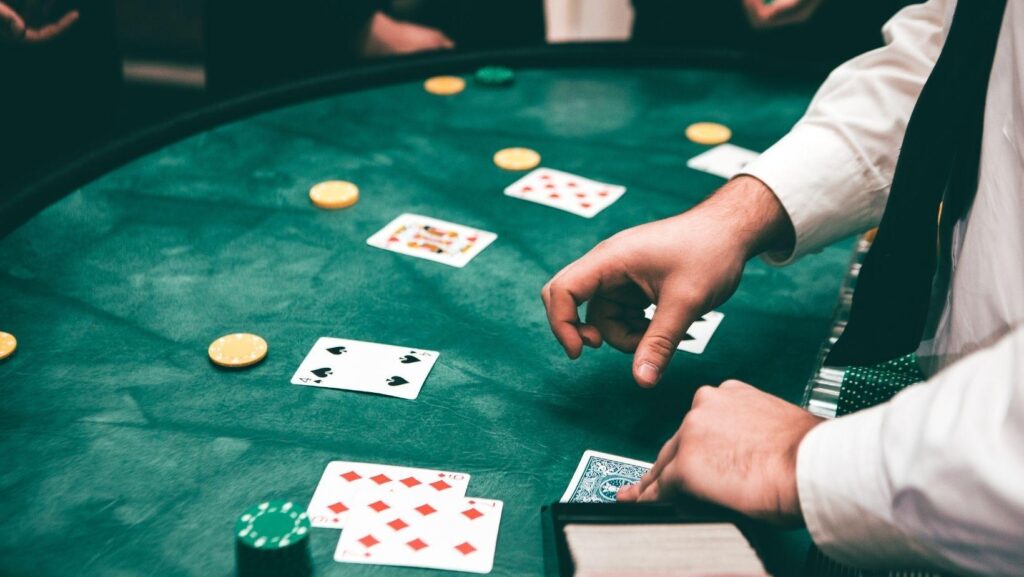
Poker is a social contract disguised as a card game. The rules take ten minutes to learn. The social layer takes years.
Every time you sit down at a poker game, you are negotiating trust, building a reputation, and reading personalities under pressure. That is the part that keeps people coming back.
Here are five social mechanics that drive the game, and what they reveal about human behavior beyond the felt.
1. Reputation Compounds Faster Than Chips
New players focus on their cards. Experienced players focus on their image.
Most people treat each hand as isolated. They do not realize that every decision is being catalogued by everyone else at the table.
Play your first few hands with the explicit goal of establishing a readable identity:
Concrete example: You fold pocket sevens preflop in a loose game. Two orbits later, you three-bet with aces. Because your reputation is tight, you get called by worse hands that would have folded against a looser player.
Your image did work your cards could not do alone.
The social parallel: this mirrors how credibility works in a workplace. Deliver early, and you earn the benefit of the doubt later. Reputation is a compounding asset.
2. Status Hierarchies Form Within Twenty Minutes
Players arrive as strangers and immediately begin sorting each other.
Humans establish social hierarchies instinctively in any group setting. At a poker table, the signals are unusually legible – chip stack size, bet sizing confidence, how a player handles a bad beat.
You are being read before you play a hand. How you buy in, how you stack your chips, how quickly you act – all of it communicates status. Control the signals deliberately.
Watch the table’s first orbit. You will see:
That informal hierarchy shapes betting patterns for the rest of the session.
3. Deception Has a Structural Cost
Players bluff too often, or not enough, without understanding why either extreme fails.
Bluffing feels like the exciting part of poker. But deception only works inside a framework of credibility. Bluff constantly and your bets carry no information – opponents call you down with weak hands.
Never bluff and your value bets get no action.
Think of your bluff-to-value ratio as a social contract. For every bluff you run, you need enough value hands in the same spot to keep your opponent uncertain. A standard guideline for a pot-sized bet: roughly one bluff for every two value hands.
Concrete example: you bet $90 into a $90 pot on the river. Your opponent needs 33% equity to call. If you only bet value hands, they fold everything.
Add one bluff for every two value combos and they cannot profitably fold or call. You have weaponized their uncertainty.
The social parallel: in negotiations, someone who never concedes loses credibility. The occasional genuine concession makes every other position more believable.
4. Table Talk Is an Information Market
Players either say too much or disengage entirely, missing one of the game’s richest data sources.
Conversation at a poker table feels casual. It is not. Every word – and every silence – is a potential tell or a potential probe.
Treat table talk as a two-way instrument:
In texas holdem poker, community cards create shared information. Talk around the flop texture is especially revealing. A player who immediately comments on a dangerous board is often not afraid of it.
Online, this dynamic shifts but does not disappear. Bet timing, time-bank use, and in-game chat all carry signal value.
Players who adapt their reads to these digital tells keep the same edge live players get from physical presence.
5. Micro-Communities Reset at Every Table
Players underestimate how much the specific group at a table shapes optimal strategy.
Poker strategy is often taught as universal. The same hand plays completely differently against five loose recreational players than against five disciplined regulars.
Spend the first two orbits mapping the group, not just the individuals. Ask:
The social dynamics between players – not just individual tendencies – determine where the value sits.
This is where playing online poker real money adds a useful dimension. GGPoker’s global player pool means you encounter a genuine cross-section of playing styles and social temperaments in a single session – aggressive recreational players, patient grinders, and everything between.
Adapting to that variety quickly is itself a learnable skill.
The Mechanic Underneath All Five
Poker forces you to make decisions about other people under uncertainty, with real consequences, in real time.
That is not a feature of the rules. It is a feature of the social architecture. The cards are just the excuse to sit down together.
The players who improve fastest are not the ones who memorize the most strategy. They are the ones who learn to read the room.